
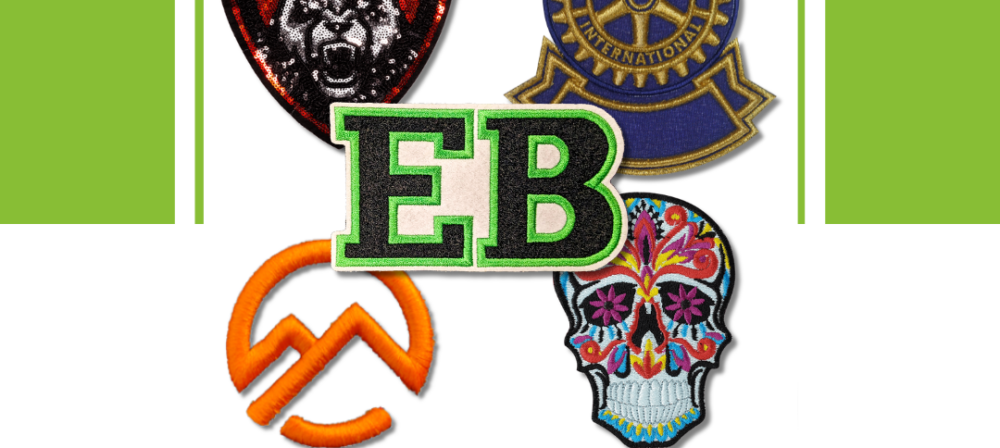
Custom embroidered patches help you present a consistent brand across uniforms, events, and merchandise—without committing to direct embroidery on every garment. In this guide, you’ll learn the practical choices that affect quality and repeatability: patch type, backing, borders, artwork rules, approvals, and care.
What are embroidered patches?
Embroidered patches are made by stitching your design onto a fabric base (often twill or felt), then finishing the edge with a border. After that, you choose how the patch will attach to the garment. Because thread has physical limits, the best results come from designs that respect stitch width, spacing, and legibility.
At Embroidery Badge UK, we manufacture embroidered patches to your specification—so whether you’re matching a brand identity, refreshing a crest, or creating uniform custom embroidered badges, you get a reliable result that can be repeated across future batches.
Application options: Iron-On (heat-seal), Sew-On, Appliqué, or Velcro. For step-by-step help, you can also review our tutorial videos for application guidance.
Why choose custom embroidered patches?
Impactful branding
Your logo or message looks more “official” when it’s stitched, not printed. As a result, patches work brilliantly for workwear, clubs, events, and retail merchandise. They also let you standardise branding across multiple garments, even when garments come from different suppliers.
Durability
With sensible artwork and correct finishing, embroidered patches can handle repeated wear and washing. For example, a clean border and sensible text size helps prevent fraying, while good stitch spacing keeps fine details clearer over time.
Versatility
You can apply patches to jackets, hats, bags, workwear, sports kits, and uniforms. In addition, Velcro-backed options make sense when you need quick swaps for roles, ranks, or limited-edition drops.
Patch options we offer
Different designs suit different build methods. Therefore, choose the patch type based on detail level, texture goals, and how the item will be used.
- 100% Embroidered Patches: Fully stitched patches with a bold, textured finish.
- Partial Embroidery with Visible Fabric (twill or felt): A cost-effective option for larger areas of solid background colour.
- 3D Puff Embroidered Patches: Raised embroidery for prominent text and standout elements.
- Chenille Embroidered Badges: A classic “towel” texture popular for varsity and sports looks.
- Faux Chenille Embroidered Badges: A chenille-style look using thread technique for sharper edges and tighter colour control.
- Eco-Green Badges: Manufactured using embroidery thread made from recycled PET bottles for a more sustainable choice.
- Special Stitch Badges: Premium stitch effects that add structure and definition beyond standard embroidery.
Design tips for better results
Good embroidery starts with good artwork. So before you order, use these rules to avoid the most common quality issues.
- Keep the design recognisable: Aim for readability from 2–3 feet away.
- Clarify the purpose: Uniform, branding, event, or decorative use can change the best patch type and finish.
- Prioritise a clean centre: Too many small elements reduce legibility once stitched.
- Minimum text size: Keep small fonts at least 5mm tall so embroidery stays readable.
- Choose the right size: Match proportions to where it will be applied (chest, sleeve, cap, bag, etc.).
The ordering process
Step 1: Request a quote
Send your artwork and requirements (size, quantity, backing type). Then we confirm pricing and turnaround based on your specification. If you already know what you want, you can place a quote directly on our website.
Step 2: Artwork and approval
Next, we prepare a production-ready digital proof for approval. Importantly, this is where you confirm sizing, text legibility, and any layout adjustments required for embroidery.
Step 3: Production
After approval, we manufacture using the agreed materials, backing, and border style. This approach helps keep results consistent, especially when you re-order later.
Step 4: Quality control and shipping
Finally, we check batches before dispatch and ship to your delivery address so your patches arrive ready to apply or distribute.
Care instructions
Simple care keeps patches looking sharp for longer. For best results:
- If the patch is sew-on, use a gentle wash cycle or hand wash where possible.
- Avoid bleach or harsh chemicals that can weaken thread and fabric.
- Air dry when possible, because high dryer heat can affect materials over time.
- If you need to press, use a cloth barrier and low heat.
Summary
When ordering custom embroidered patches, focus on patch type, size, border, backing, and legibility rules. With the right build choices, embroidered patches become a durable, professional branding tool you can repeat across uniforms, events, and merchandise.
